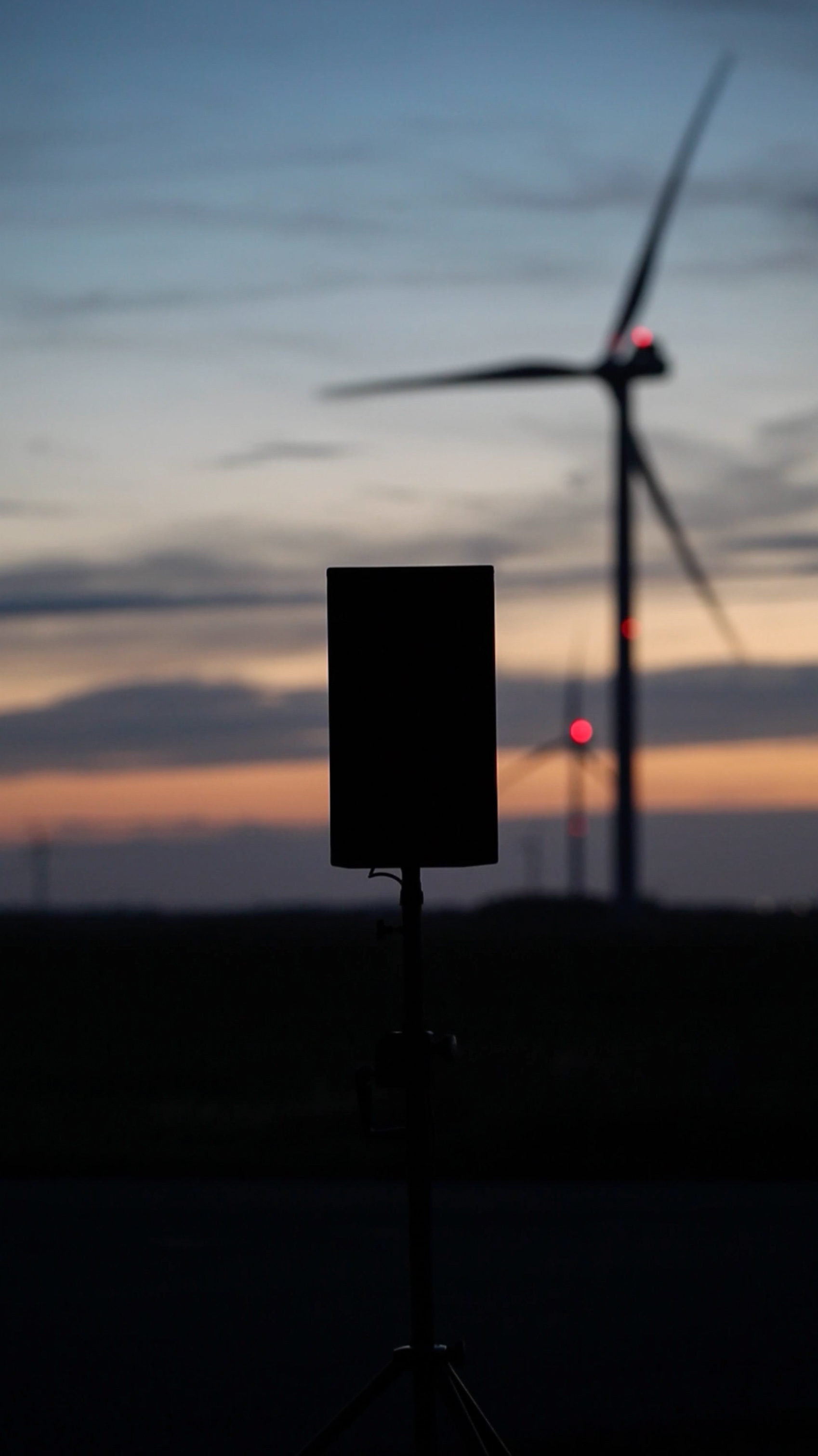
in danger as a whole is a video installation commissioned by the Muziekgebouw in Amsterdam, Gaudeamus in Utrecht and Musica in Strasbourg. The work is part of the project The State of Music, inviting 17 composers to reflect on Louis Andriessen’s composition De Staat by writing a single page of instructions or a graphic score. These pages were then realised as a performative exhibition alongside concerts of De Staat, presented in the three venues in September 2024. De Staat is inspired by Plato’s The Republic, with Andriessen using text excerpts as lyrics for his composition. I borrowed a phrase from one of these excerpts to give the title to my work.
The installation places a speaker on a tripod inside three very different locations, each time playing De Staat: a piece of farmland in the Netherlands among wind turbines, a construction site in Athens of a building that was never completed and is planned to become an institution, and a venue in my hometown Larissa that has been built and rebuilt for about 25 years. In the exhibition, an actual speaker on a tripod is placed opposite the video screen, playing the audio part of the work. The filmed speaker and the physical speaker face each other, with the audience standing in-between.


ὡς ἐν ὅλῳ κινδυνεύοντα / in danger as a whole / en danger dans son ensemble
From Plato’s Republic:
μὴ πολλάκις τὸν ποιητήν τις οἴηται λέγειν οὐκ ᾄσματα νέα ἀλλὰ τρόπον ᾠδῆς νέον, καὶ τοῦτο ἐπαινῇ. δεῖ δʼ οὔτʼ ἐπαινεῖν τὸ τοιοῦτον οὔτε ὑπολαμβάνειν. εἶδος γὰρ καινὸν μουσικῆς μεταβάλλειν εὐλαβητέον ὡς ἐν ὅλῳ κινδυνεύοντα· οὐδαμοῦ γὰρ κινοῦνται μουσικῆς τρόποι ἄνευ πολιτικῶν νόμων τῶν μεγίστων (…)
out of fear that some often suppose that the poet is speaking not of new songs but of a new style of singing, and that he is expressing group approval for such a thing – but this should neither be praised nor accepted. In fact, one must be careful about changing to a new musical form, on the grounds that it puts everything in danger as a whole. Musical styles never change without modifying the most important political laws too (…)
What are a state’s institutions?
What is their sound?
What is the sound of their absence or collapse, the sound of their construction?
Who is watching, who is listening, who is making decisions?
Those who watch and listen decide to make their way to the institution, to the concert hall, to the theatre; they decide to come together. By being present with their bodies in the building, they already complete a political gesture. I use the term political as in the Greek language, where πολίτης (polítis) is the citizen and the word πόλις (pólis) means city, leading to Πολιτεία (Politía) by Plato, which deals with the ways a city-state should be governed.
The work moves through different bodies of institution and non-institution: it starts from the venue itself as an existing cultural institution, passes through buildings that are unfinished, delayed or still becoming one, and reaches the farmland outside the city. The building can be imagined as the body of an institution: something that can exist, be absent, remain unfinished or stay permanently under construction.
At the same time, the countryside around the city is not outside this political structure. It keeps the city alive and, in times of neglect, has the potential power to block or even disrupt its institutions. The work manifests through De Staat by Louis Andriessen, displacing space, time and potentially the audience itself. The two facing speakers place the audience between an image of a speaker and an actual one, between a recorded location and the institution in which they are present. For the presentation at Musica in Strasbourg, new video material from the city’s opera house was added, bringing another of the city’s institutions into the work and creating a more direct dialogue with the place where it was being presented.
Presentations:
4 Sep Gaudeamus, TivoliVredenburg, Utrecht
12 Sep Muziekgebouw, Amsterdam
20 Sep Festival Musica, Maillon, Strasbourg


Special thanks for the production of the work to the Muziekgebouw & their amazing team, Gaudeamus, Festival Musica Strasbourg, Performing Arts Fund NL, Onassis Culture, Thessaliko Theatre, Municipality of Larissa, Yannis Michalopoulos, Fotini Papachristopoulou, Nikos Karatzios, Kostas Chaikalis, Dimitris Tasenas, Niki Skiadaresi, Konstantinos Melidis, Alexios Papazacharias, Yorgos Samaras, Yorgos Deligiannis, Trevor Grahl.