
Intro
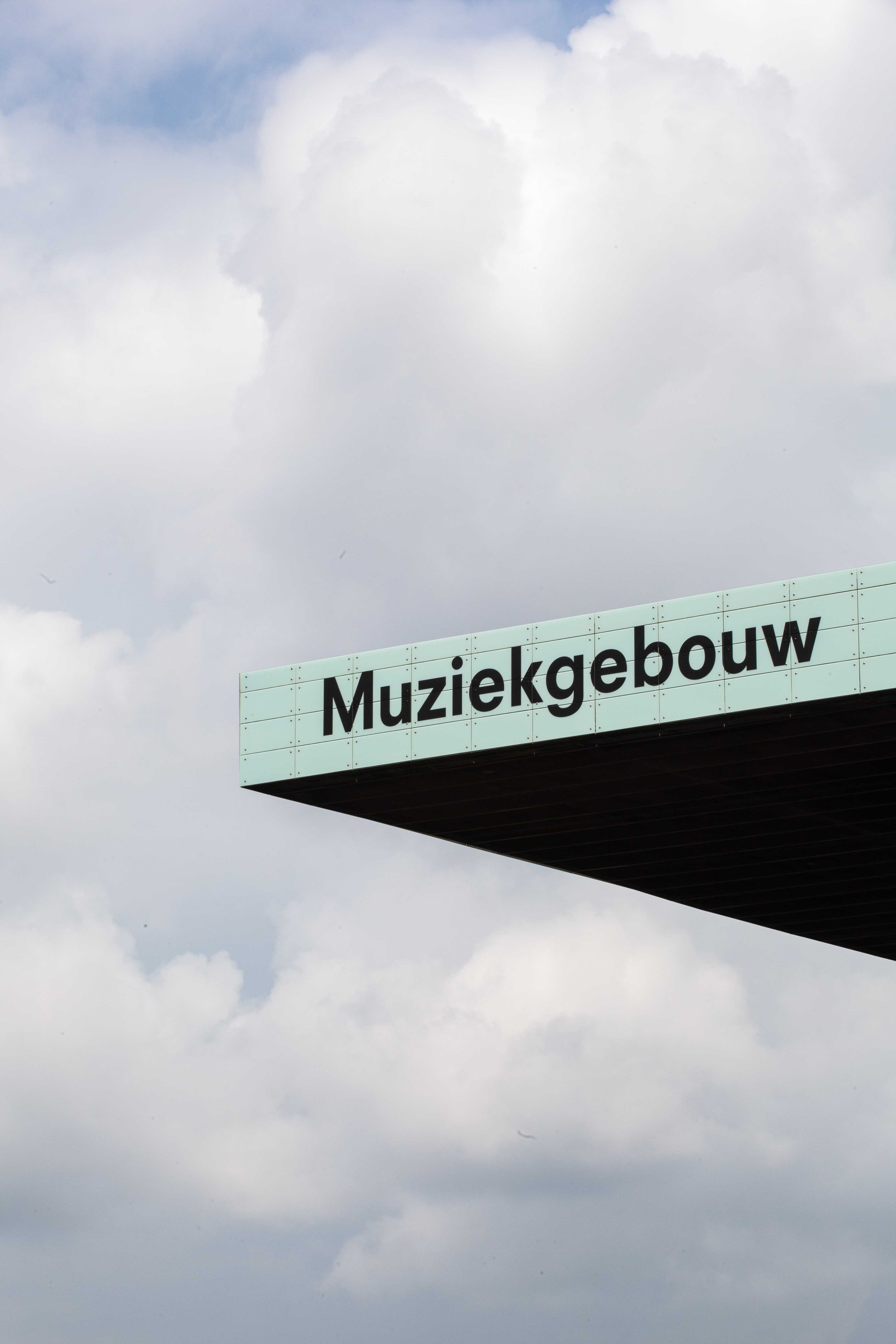
The Muziekgebouw Productiehuis is an initiative of the venue aiming to support innovation in contemporary music and sound culture. I was invited by Joost Heijthuijsen for a residency with a focus on exploring the possibilities of the building and its workforce. Working closely with my collaborator and co-director on previous projects, Yannis Michalopoulos, and being backed by I/O, we put on the table – or better on the wall – a couple of main questions:
What kind of engaging experiences can we create for the audience in a dialogue with the very building?
What shape can our ongoing research on rural and agricultural cultures take in such an urban venue?
The residency began while Xirómero/Dryland was being exhibited at the Greek Pavilion of the Venice Biennale 2024. Although much of the material we brought into the Muziekgebouw came from the earlier Margaroni Residency, developed by Yannis Michalopoulos and me as Onassis AiR Fellows in 2022-23, the intention was to make a new step rather than continue the Venice work. The two processes therefore ran in parallel: one work was unfolding in Venice while, in Amsterdam, we began testing how this material could open up again within a very different building and working context. The process eventually led to the performance installation Nightwater, in collaboration with Ensemble Klang.
“Hello again”
My first contact with the Muziekgebouw goes back to 2007, when I moved to Amsterdam as a composition student. In a different time, in a different cultural landscape in the Netherlands, we used to visit numerous concerts at the venue. We generally thought of the building as our “home”. My first job in the music sector in Amsterdam was assistant director at the Nieuw Ensemble; a key to enter the building was given to me, going to the office a few times a week. Back then all contemporary music ensembles had their offices at the Muziekgebouw. Nieuw Ensemble used to perform very often in the building and throughout those years I got to know the tech of the main hall, the production behind such events, the ways to programme a concert and host an audience. After the big budget cuts in the Netherlands, with the ensemble culture being in suspense, it seems like I couldn’t just cut myself off completely from the building, as I continued returning as a teacher at the Conservatorium van Amsterdam (a building in the neighbourhood of the Muziekgebouw): an annual tour is specially organised for my students, during which we walk through every possible passage, discovering most of the venue’s secrets and being guided by and discussing with a technician, a producer or even a programmer of the Muziekgebouw.


Calendar (click-on dates)
May 20-26 a meeting place
June 10-24 re-imagining the building
July 25 – August 2 designing a test
August 5-19 the tryout
September 1-19 starting the wrap up
October 24-27 the microtonal Fokker organ

May 20-26 a meeting place
Let’s begin with another question:
What would it sound like if we would be standing at the very spot where the Muziekgebouw stands, but it had never been built?
A first reaction to the residency was the feeling that I didn’t have much to explore after all these years of being around, having visited almost all possible corners and having tried out ideas such as playing tennis in a completely empty hall (I/O 2013), re-creating a rural cabaret (re- draft 2018) or placing speakers under the audience, bringing a fridge on stage and having the ensemble perform from the loading dock while the keyboardist (only) sounds from a speaker in the fridge (μ 2021). But I convinced myself that with a researcher’s mentality new discoveries would emerge. Joost was a great contributor to this. He helped me get in contact with most of the people working at the organisation, and we engaged in an ongoing dialogue about the building and its programming. Quite unexpectedly he introduced me to the building’s history by stepping onto a chair one day to get a large dossier from a high shelf. It contained the application submitted for the Muziekgebouw’s foundation, put together by the people of the Ijsbreker. Joost, Yannis and I started conversations on the past, the present and the future of the building, with nice questions coming in from the Productiehuis’ producer Leonie Baars.
A wall to think on / May
On the first day of the residency we agreed that I would have a wall in the building where I could gather ideas and any kind of material throughout the residency. Walking here and there, checking if Reinbert de Leeuw’s smoking room would be a good option, we eventually ended up with a wall at the offices of the Muziekgebouw, in front of the programmers and producers. In the beginning it was a bit intimidating as I had never worked in front of others this way, but it proved to be quite fun and liberating – mostly because the team at the office has been very inclusive and supportive.

Next to walking through the building again and again, getting to know the people and taking photos of almost every angle, corner, wall, and staircase, I got the chance to attend events the venue programmes. It was a great opportunity to revisit what kind of audience goes to what event, how the venue functions when such audiences are in house, what the whole experience feels like. The building offers a lot of possibilities, however, it is always a matter of keeping the balance between artistic ideas, budget and audience numbers. How can we create something engaging and new (in whatever way new can be defined) and where is that fine line that, when crossed, the compromise is too large for an idea to be realised in an artistically meaningful way?


June 10-24 re-imagining the building
June reconfirmed the versatility of the building through the different performances of the international Holland Festival that took place at the Muziekgebouw. It was a coincidence that I was also selected for Immerse, a program that accommodates a small international group of artists to visit the festival, get to know each other and meet artists featured in the programme. I had the chance to study the transformation of the Grote Zaal’s stage and the way the foyers are being used to host the audience, parallel events and a party.
A wall to think on / June
The notes on the wall get reformed. I start shaping the points of the building’s main joints and connecting the dots. I count and recount the halls, the foyers, the backstage spaces until the whole building is in my head like a 3D map: the Grote Zaal (main hall), the Kleine Zaal (small hall that hosts the microtonal Fokker Organ), Entreehal, Foyerdeck 1, 2, 3, the Atrium, the Loading Dock, rehearsal studios 1, 2, 3, backstage passages, storage spaces, the underground parking.

The ongoing discussion with Joost and Yannis continues, as well as getting to know the technicians and personnel who work in the building. Many stories of the past, fun projects that they remember, and strange uses of the spaces are shared. Something reoccurring was the fact that the foyers are public space that belongs to the city, meaning the building is open to the public no matter what is happening in the halls. In these discussions we invited Voltnoi Brege, one half of the curatorial duo DETACH who direct Stegi Radio. Voltnoi visited Amsterdam and the Muziekgebouw, we went through ideas and plans all together, walked once more through the building, remembered the Margaroni Residency and went through the notes on the wall. We let things sit and impregnate the future.

July 25 – August 2 designing a test
A wall to think on / July
July was full of technical questions, plans and solutions for how to conduct a large-scale test in August with the available means. From our experience of the Margaroni Residency we knew that when working with large and multiple spaces things take time, there’s a lot of walking back and forth, synchronisation (if needed) is a challenge, and that flexibility in design is a must. So we started making a list of the spaces we wanted to include in our test throughout the building, the available time to build up, the available speakers, projectors, computers and connections.

August 5-19 the tryout
We moved my desk from the office to Studio 2 for a couple of weeks. With the Muziekgebouw being a powerhouse, I’m very grateful that my ideal workspace could be created: 4 speakers, a large desk, a large TV screen, an additional projector. The headquarters were ready to finalise the design of the test throughout the building. Bart Mesman (technical director of the Muziekgebouw), Gerco van Veenen and Jaap (technicians) joined us and turned plans into reality. Connecting the various spaces was a puzzle, but one we managed to put together and that was very inspiring and optimistic for what we plan for the future. Next to the tech, we were in contact with the marketing & communication team of the Productiehuis, through Gigi Blay, Vera van Duuren and Yohann Pollet. For the test we invited a small group as a test audience, among whom Frank van der Weij (project manager of I/O). We switched everything on, entered from one of the loading doors and had a 2-hour walk from space to space, back and forth, checking how the dialogue between the content of the artistic research and the building itself works out.
A wall to think on / August
Moving post-its, photos, notes and ideas around again and again gave a final shape to the plan on the office wall. An approach to space and material became clear; we should not treat it as scenography. I am not interested in making theatre, we should rather explore that intermediate space between an installation and an event. An immersive experience that encompasses the audience itself as bodies being in space – and moving in space -, the various installations that create a functional environment with which the performers or even the audience can interact (e.g. simply by walking through or on it), and of course a mixed sound world that will be engulfing everything. Sound will be the guide and we should let it bounce off all sorts of surfaces and walls, cross all possible spaces from door to door, and let the audience find the points in the building where different sound worlds crossfade.

September 1-19 starting the wrap-up
September coincided with the presentation of the project State of Music and in danger as a whole, which was produced with the full support of the Muziekgebouw. Throughout the residency a very interesting dialogue was taking place in parallel with the rest; the stories and memories Pauline Mouw was sharing about the various projects throughout the history of the building. Pauline is one of the venue’s light technicians. I would like to thank her for thinking along with us about what this building has been, is and can be.
Moving on
We started wrapping-up the residency, cleaning the office and our equipment, but to my surprise we were asked to leave the notes on the wall. In September a kick-off meeting of the Muziekgebouw Productiehuis took place, bringing all artists involved together – we certainly are a community! It felt very nice being part of it. The residency gave us the opportunity to test our ideas and get a few steps closer to realising them. It left us busy actually working on making these ideas happen, towards a large-scale work in season 2025-26.

October 24-26 The microtonal Fokker organ
Last but not least, I had the chance to put my hands on the Fokker Organ which is installed in the Kleine Zaal of the Muziekgebouw. The instrument has a long history and has been housed in the building since 2009, belonging to the Huygens-Fokker Foundation. What is very special about this organ is that it is microtonal, dividing each octave into 31 parts, based on meantone tuning, and it can either be played through the enhanced keyboard or be controlled by computer via MIDI signals. There are also 4 speakers integrated among the pipes, making it easier to mix electronics or even create a hybrid organ using the actual microtonal pipes and sampled organ sounds of any possible tuning.
What followed
The residency gave birth to Nightwater, a new work created specifically for the Muziekgebouw and in dialogue with its building, presented there in September 2025. We returned to material first developed during the Margaroni Residency in Athens (2022-23), while bringing in parts that had also gone through Xirómero/Dryland in Venice (2024). At the Muziekgebouw, we could open this material up, spread it through the building and work with it on a much larger scale, together with new material that emerged during and after the residency.
A lot of what we tested during these months stayed with the work: moving through different parts of the building, allowing different events to happen in parallel, using sound to connect spaces that were otherwise far apart, and thinking of the audience itself as bodies experiencing this environment. The building was not simply a place where the work would later be presented. Its passages, halls, foyers, acoustics and technical possibilities became part of how Nightwater was composed, and so did inventing ways people could potentially inhabit it.
