Introduction
Deligiannis’s work at the Conservatorium van Amsterdam (CvA) has developed through courses, festivals, exchanges, collaborations and individual guidance, connecting artistic practice, research and different ways of organising and designing learning, collaboration and artistic exchange. This page brings those strands together: it outlines the ideas that shape his teaching, traces the origins and development of several long-term initiatives, and looks closely at the contexts in which students, teachers, artists and institutions meet. Readers can move directly from the educational approach to any individual project or advisory role, while some chapters also contain year-by-year records of recurring projects and platforms.
On this page
— Educational Approach
Courses, Platforms and Collaborations
—— Transdisciplinary Approaches
—— Composers’ Festival
—— An Evening of Today
—— SNDO-Choreography × CvA Exchange
—— Dutch National Ballet
— Teaching and Advising
— Related Pages
Educational Approach
Artistic practice as the starting point
An educational approach centred not on the production of a particular kind of work, but on the practice through which the work comes into being. Every artistic practice carries the traces of a person’s formation, experiences, references, social and political environment, habits, instincts and resistances. Education begins by making these ways of working visible: analysing them, identifying core functions, questioning assumptions, testing unfamiliar methods and redesigning the conditions through which ideas are developed. Craft and technique remain important, but they are placed within a larger inquiry into how someone thinks, works and makes decisions as an artist.
The conditions of making
An artistic work does not emerge from ideas alone. It is shaped by the circumstances in which it is made: the time and space available, the people involved, material and technical resources, institutional frameworks, budgets, modes of production and forms of presentation. These are not external limitations around the work, but factors that influence its scale, rhythm, structure and relationships. Consciously shaping them therefore becomes part of the artistic task: determining the duration of research and creation; when collaborators enter and how responsibilities are distributed; what kind of working relationship is established among them; at which stage tools, technologies and material resources enter the process, and how they interact with or transform the artistic material; how workshops and rehearsals are organised; where and under what circumstances decisions are made; and how the work will eventually encounter its audience.
Interdisciplinary encounters
Interdisciplinary work is not simply the combination of media or disciplines, but an encounter between different artistic cultures, methods and ways of thinking. Educational projects create spaces in which these encounters can be experienced, examined and negotiated. Students are encouraged to become acquainted with the vocabularies, tools and methodologies of other fields, as well as with the practitioners who shape, create, perform, construct, operate and otherwise bring work into being. The aim is to enter a reciprocal exchange — to allow one’s own way of working to be influenced, while also influencing the practices and people involved.
Education as research
Education can function as a collective field of exploration, where questions are not only answered but generated, and where the positions of teacher, student, artist and collaborator can shift. Courses, exchanges, festivals and collaborative platforms create temporary working structures in which different experiences, methods and responsibilities meet, and in which the format itself can be tested and revised through use.
Research is not a preparatory activity placed before the real work. Research is already a way of making: observing, listening, testing, entering into dialogue and allowing a project to reveal what it needs in order to develop. Research allows a project to discover not only what it may become, but how, with whom, where and under which circumstances it needs to be made. Research and reflection extend compositional thinking beyond the organisation of sound: compositional tools can also be applied to time, visual material, space, movement, relationships, methods and situations, expanding the very idea of what composing can be.
Transdisciplinary Approaches
Introduction
Transdisciplinary Approaches is a year-long master’s elective at the CvA that brings together composers, live electronics musicians and creative instrumentalists to explore how artistic practices can inform and expand one another across disciplinary boundaries. Through seminars, physical workshops, guided visits to artistic institutions and ongoing reflection, students are invited to translate tools and approaches from other disciplines into the context of their own practice. Rather than culminating in a final performance, the course unfolds through a continuous dialogue between discourse and embodied exploration, creating a space where different ideas, methods and artistic perspectives can coexist and interact.
Origins (2018–2020)
The course originated between 2018 and 2020 as a pilot project developed at the CvA. As Deligiannis’ work increasingly moved across composition, performance, installation and direction, he became interested in educational formats capable of supporting similarly hybrid ways of thinking and working. The title Transdisciplinary Approaches was inspired by Paul Craenen’s essay Notes on Transdisciplinary Sounding Art, which Deligiannis encountered a few years after studying in Craenen’s master’s course Resounding Intermedia. Both the course and the essay articulated ways of thinking beyond disciplinary boundaries that resonated with questions he was already exploring.
Educational Framework
In 2021, the project was introduced as a master’s elective at the CvA. Since then, it has continued to evolve through each new edition of the course, shaped both by the questions students bring into it and by developments in contemporary artistic practice. Initially conceived as a compact programme of seminars and a five-day workshop, it has gradually expanded into a two-semester course that allows more time for physical exploration, discussion and reflection, while giving students space to develop questions emerging from their own artistic research. Although its format continues to evolve each year, its central aim has remained unchanged: to introduce students to inter- and transdisciplinary ways of thinking and working, inviting them to rethink and potentially expand their own artistic practice.
In recent years, the course has adopted the subtitle Composing in Time and Space, reflecting an expanded understanding of composition that extends beyond sound to include the body, movement, objects, architecture, social interaction and the conditions through which an artistic experience is shaped.
Seminars
The seminars combine artistic case studies, documentary material, theoretical texts and group discussion. Through the work and writings of composers, directors, choreographers, visual artists and theorists — including Heiner Goebbels, Mauricio Kagel, Pina Bausch, Iannis Xenakis, Georges Aperghis, Jennifer Walshe, Romeo Castellucci, Simon Steen-Andersen, Dimitris Papaioannou and Anne Teresa De Keersmaeker — students examine different approaches to composition, collaboration and artistic research. Readings are complemented by recordings, films, interviews and documentation of artistic processes, creating multiple entry points for discussion and critical reflection.
Physical Workshops
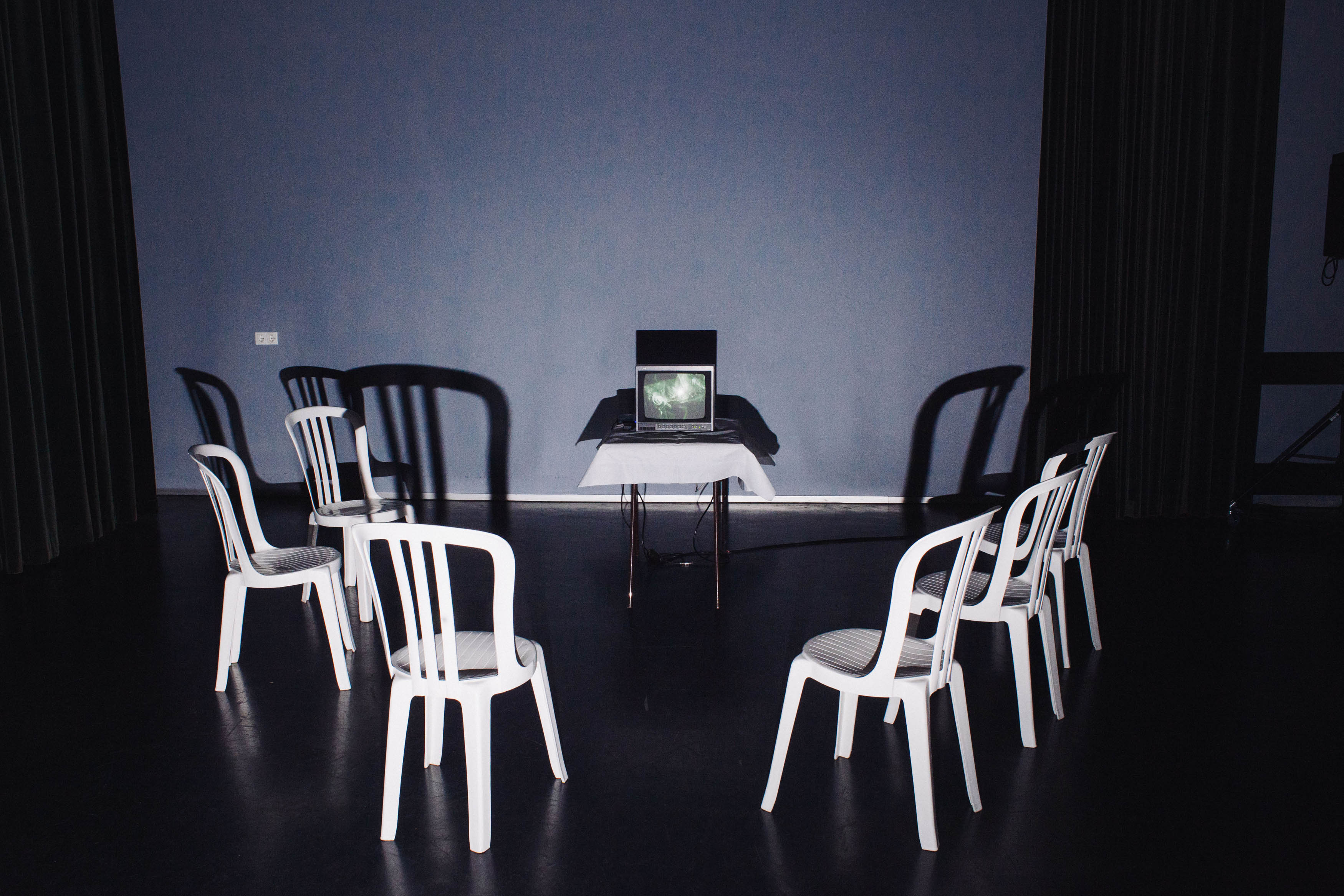
The workshops function as an experimental laboratory where students are introduced to a hybrid set of tools and working methods drawn from composition, performance making and visual artistic practices. Beginning with a simple everyday object—a chair—the group gradually develops a shared performative vocabulary through short physical phrases, controlled improvisation and collective exercises. By applying compositional principles such as repetition, variation, rhythm, contrast and form to bodies, objects and space, students learn how performative situations can be composed, designed and developed. Working collectively, students gradually become familiar with the vocabulary and approaches of other disciplines, equipping them to adapt these approaches into their own artistic practice when appropriate.
Institutional Visits
Throughout the year, the course includes guided visits to cultural institutions such as the Muziekgebouw and the Academy of Theatre and Dance (ATD) of the Amsterdam University of the Arts (AHK). These visits offer insight into artistic production, institutional practice and interdisciplinary collaboration, while rehearsal visits provide a closer understanding of how artistic projects are developed and realised in professional contexts. They also create opportunities to discuss how institutions shape artistic production through their relationship with audiences, collaboration between departments, and the reciprocal relationship between artistic practice and the available infrastructure.
Reflection & Assessment
Reflection runs throughout the course. Through an online diary, questionnaires and collective discussion, students document their observations, connect experiences across the different components of the course and gradually articulate their own artistic questions and perspectives. These reflections contribute to the assessment, which emphasises active participation, sustained engagement and an active relationship with each student’s own artistic research. The course concludes with a collective evaluation discussion, inviting students to reflect on the course itself and its various elements. The online diaries are then returned to the students, allowing them to assess in a personal way their own trajectory throughout the course.
Impact
Students have described the course as opening new perspectives on composition, performance and collaboration, often leading them to reconsider the relationship between their own discipline and other artistic practices. Across different editions, recurring reflections point to a growing awareness of space, movement, collective processes and interdisciplinary working methods, as well as a renewed understanding of artistic research as an open and evolving practice. Selected excerpts from students’ reflections are included below.
Students’ Reflections
“I wish I could do more with not just music. I feel this class gave me an insight on my inner need to express in a rounded way, with words, movements, music, crafts, people.”
— Instrumentalist student
“These three days made it very clear how the process of an improvisatory approach can be very similar for any medium.”
— Live electronics student
“I felt more open for experiments with the space… good to realize that I’m not just a player, I’m also creator and the space and everything is very important.”
— Instrumentalist student
“It is so clear how important it is to create a working team, and how often it is underestimated (in terms of time and conditions), in music performances.”
— Live electronics student
“The walking on diagonal line exercise did make me think of how form develops in my music. It’s like this exercise, where simple steps are required for clear perception of the form.”
— Composition student
“Today I felt a need to rethink some automatic answers and comments I give to myself and others. The real ‘why’ for why I’m interested in something is sometimes deeper and less obvious than I realise.”
— Composition student
Looking Ahead
Transdisciplinary Approaches continues to evolve alongside Deligiannis’ artistic practice and research. A longer-term ambition is to expand the course into a transdisciplinary research platform operating across the academies of the AHK. Rather than functioning as another interdisciplinary project, the platform would create a shared environment in which students, staff and external partners from different disciplines could exchange methodologies, test new working approaches and investigate artistic questions through practice-based research.
Conceived as a transversal initiative across existing educational structures, the platform would encourage participants to bring the knowledge developed within it back into their own departments, allowing different disciplines to fertilise one another while maintaining their individual identities. Alongside research intensives and institutional partnerships, the platform would gradually build an open research archive documenting discussions, round tables, lectures, working methodologies, experiments, artistic challenges and try-outs. The archive would serve as an accessible and continuously expanding body of knowledge for artists, educators and researchers interested in inter- and transdisciplinary artistic practice, within the AHK and beyond.
Composers’ Festival
The Composers’ Festival is the annual graduation platform of the CvA Composition Department. Held over three days each May, it enables graduating bachelor’s and master’s students to present major works developed during their studies or realise new projects initiated specifically for the festival. Most of the programme consists of premieres and includes a wide variety of genres and formats: orchestral and chamber music, electronic works, organ music, music theatre, solo performances, audiovisual installations, interactive projects and other hybrid formats. Events take place across the concert halls and other spaces of the CvA, as well as at partner venues in Amsterdam.
Origins and Development
The predecessor of the festival was Hutspot, a graduation format initiated by composition students in 2009. Their individual graduation concerts were spread across approximately one week, with each student largely responsible for organising their own concert. In 2010, the graduating bachelor’s and master’s students condensed these separate events into a three-day festival and combined their works within shared concert programmes. This shift placed greater attention on the relationship between the different works, the overall programme and the experience of a shared audience. From 2011 to 2016, the platform was known as Composers’ Festival Amsterdam, returning to the shorter title Composers’ Festival in 2017.
Deligiannis took part in the first edition in 2010 as a graduating master’s student and coordinated the festival from within that year’s graduating group. After completing his studies, he continued as its production coordinator. Over time, this position developed into that of a creative producer and project leader, and subsequently into a teaching and coaching role.
The preparation period initially lasted approximately three months. Deligiannis gradually expanded it to a complete academic year. Each new edition begins with a meeting in June, shortly after the previous festival has ended. Across the following months, the graduating students develop the programme while addressing its artistic, technical, financial and organisational requirements.
Festival Editions 2010-2026

2010
Graduating composers: Caio Amon, Thanasis Deligiannis, Natalia Dominguez, Rafael Fraga, Max Knigge, Diederik Saeijs, Maurizio Tessitore, Onur Yildirim
Other composers in the programme: Danai Bletsa, Anthony Dunstan, Dominic Floyd, Ji Youn Kang, Paul Leenhouts, Roderik de Man, Quang Ngohong
Venues and spaces: CvA Bernard Haitinkzaal, Theaterzaal, Mezzanine and Canteen
Ensembles involved: Composers’ Cultures Collective; ad hoc groups and ensembles of CvA, Theaterschool and Film Academy students
2011
Graduating composers: Anthony Dunstan, Emre Kaleli, Ji Youn Kang, Noriko Koide, Andys Skordis, Thierry Tidrow, Rens Tienstra, Mátyás Weltt
Other composers in the programme: Giuliano Bracci, Fátima Fonte, Trevor Grahl, Johanna Groot Bluemink, Vladan Kulisic, Felipe Ignacio Noriega, Yu Oda, Max Shalygin, Valentin Villard
Venues and spaces: CvA Bernard Haitinkzaal, Theaterzaal and Canteen; Orgelpark.
Ensembles involved: Nieuw Ensemble — Transmission Possible; ad hoc groups and ensembles of CvA students
2012
Graduating composers: Danai Bletsa, Giuliano Bracci, Fátima Fonte, Trevor Grahl, Noriko Koide, Yu Oda, Kaveh Vares, Valentin Villard,
Other composers in the programme: Brechtje van Dijk, Kaja Draksler, Emil Tan Erten, Said Gani, Enis Gümüş, Hugo Harmen, Igor Iofe, Hisashi Ishihara, Kieran Klaassen, Felipe Ignacio Noriega, Benedict Schlepper-Connolly, Rens Tienstra, Jelle Verstraten, Mátyás Wettl
Venues and spaces: CvA Bernard Haitinkzaal, Theaterzaal, Mezzanine and Canteen; Orgelpark; Veem Werkgebouw
Ensembles involved: Nieuw Ensemble — Alles kan! Kan alles?; Looptail; ad hoc groups and ensembles of CvA students
2013
Graduating composers: Chris Chamoun, Kaja Draksler, Said Gani, Johanna Groot Bluemink, Igor Iofe, Bram Kortekaas, Felipe Ignacio Noriega, Wilma Pistorius, Warre Simons, Emil Tan Erten, Rens Tienstra, Brechtje van Dijk, Mátyás Wettl, Lucas Wiegerink
Other composers in the programme: Kieran Klaassen
Venues and spaces: CvA Bernard Haitinkzaal, Theaterzaal, Amsterdam Blue Note and Canteen; Orgelpark
Ensembles involved: Amsterdam Collage Ensemble; ad hoc chamber and vocal ensembles, and music-theatre groups of CvA students
2014
Graduating composers: Danai Bletsa, Giuliano Bracci, Mathias Coppens, Kieran Klaassen, Flora Koene, Jamie Man, Shoko Nagamachi, Alex Peringer, Kaveh Vares, Jelle Verstraten
Other composers in the programme: Jurek Bielski, Seán ó Dálaigh, Haukur Þór Harðarson, Manu Sánchez García
Venues and spaces: CvA Bernard Haitinkzaal, Theaterzaal, Canteen and other spaces; Orgelpark; Veem Werkgebouw; Butcher’s Tears
Ensembles involved: Ensemble FIVE; ad hoc chamber ensembles and groups of CvA students
2015
Graduating composers: Jurek Bielski, Chris Chamoun, Duri Collenberg, Seán ó Dálaigh, Amit Gur, Gunnar Gunnsteinsson, Haukur Þór Harðarson, Luca Petracca, Manu Sánchez García, Tijmen van Tol
Other composers in the programme: Luke Deane
Venues and spaces: CvA Bernard Haitinkzaal and Amsterdam Blue Note; Orgelpark; Veem Theater; Veem Werkgebouw
Ensembles involved: Score Collective; Futurists; ad hoc chamber ensembles and groups of CvA students
2016
Graduating composers: Boris Bezemer, David Collier, Luke Deane, Darragh Kearns-Hayes, Flora Koene, César Lüttger, Gísli Magnússon, Tom Schipper, Rick van Veldhuizen, Mathilde Wantenaar
Other composers in the programme: Siying Li, Marcelo Chacur Politano, Tijmen van Tol,
Venues and spaces: CvA Bernard Haitinkzaal, Theaterzaal and Canteen; Orgelpark; Veem House for Performance; Veem Werkgebouw
Ensembles involved: Score Collective; ad hoc chamber ensembles and groups of CvA students
2017
Graduating composers: Luka Batista, Boris Bezemer, Brechtje van Dijk, Marcelo Chacur Politano, Siying Li, Tijmen van Tol, Carmen Vanderveken
Other composers in the programme: Carlo Diaz, David Ko, Floris Kappeyne, Kate Honey, Adam Łukawski, Melle Heij, Silvia Lanao Aregay, Pepijn Streng
Venues and spaces: CvA Bernard Haitinkzaal, Theaterzaal and other spaces; Orgelpark; Splendor; ATD; Veem Werkgebouw
Ensembles involved: Score Collective; Jerboah; Luka Batista Trio; Floris Kappeyne Trio; Bad Tempered Duo; ad hoc chamber ensembles and groups of CvA students
2018
Graduating composers: Danai Belosinof, Carlo Diaz, Kate Honey, Simon Knighton, Matteo Nicolin, Nika Pasuri, Mariell Vain
Other composers in the programme: Thomas Brown, Leon Haxby, Nuno Lobo, Adam Łukawski
Venues and spaces: CvA Bernard Haitinkzaal, Theaterzaal, Amsterdam Blue Note and room 803; Orgelpark; Concertgemaal
Ensembles involved: Ad hoc chamber orchestra; ad hoc chamber ensembles and groups of CvA students
2019
Graduating composers: Thomas Brown, David Ko, Leon Haxby, Nuno Lobo, Adam Łukawski, Dennis Matos, Silvia Lanao Aregay, Pepijn Streng, Bas van Yperen
Other composers in the programme: Alberto Granados Reguilón, Andrea Guterres, Raivis Misjuns, Pol Requesens Roca, Chonglian Yu
Venues and spaces: CvA Bernard Haitinkzaal, Theaterzaal, Amsterdam Blue Note, Sweelinckzaal; Orgelpark
Ensembles involved: Score Collective; ad hoc chamber ensembles and groups of CvA students
2020 — online edition
Graduating composers: Paul Maurice Dekker, Alberto Granados Reguilón, Andrea Guterres, Frieda Gustavs, Melle Heij, Pol Requesens Roca, Chonglian Yu
Other composers in the programme: Dimitri Geelhoed, Jasmine Karimova, Francisca Martins
Venues and spaces: Online live festival, with works and interviews recorded or streamed from multiple private, studio and performance locations
Ensembles involved: Score Collective was planned for the physical edition but postponed
2021 — online / hybrid edition
Graduating composers: Ramin Amin Tafreshi, Lautaro Hochman, Silvia Lanao Aregay, Adam Łukawski, Francisca Martins, Raivis Misjuns
Other composers in the programme: Béla Braack, Jasmine Karimova
Venues and spaces: CvA Bernard Haitinkzaal, Theaterzaal, Amsterdam Blue Note; Orgelpark; online presentation and streaming
Ensembles involved: Score Collective; Maat Saxophone Quartet; Melqui; COW Shift Z; ad hoc chamber ensembles and groups of CvA students
2022
Graduating composers: Arieh Chrem Paz, Frieda Gustavs, Arjan Linker, Apollonio Maiello, Pia P. Reš, Philip Przybyło, Elizabete Beāte Rudzinska
Other composers in the programme: Béla Braack, Harry Golden, Melle Heij, Tom Koudijs
Venues and spaces: CvA Bernard Haitinkzaal, Theaterzaal, Ensemblezaal, Sweelinckzaal, Amsterdam Blue Note, and other spaces; Orgelpark
Ensembles involved: Score Collective; Nachtlicht; The Rev. Wookie Milson Quartet; ad hoc chamber ensembles and groups of CvA students
2023
Graduating composers: Ramin Amin Tafreshi, Harry Golden, Floris Heijdra, Primo Ish-Hurwitz, David Ko / Kavid Do, Tom Koudijs, Koen Oosterhuis
Other composers in the programme: Catharina Clement, George Demetriou, Wim Henderickx, Julian Tjon Sack Kie, Henrijs Poikāns, Philip Przybyło, Elizabete Beāte Rudzinska, Anne Teikari
Venues and spaces: CvA Bernard Haitinkzaal, Theaterzaal, Ensemblezaal, Amsterdam Blue Note, room 803 and Mezzanine; Orgelpark
Ensembles involved: Score Collective; Fontana Kwartet; Dianto Reed Quintet; Mellonta; The Rev. Wookie Milson Quartet; ad hoc chamber ensembles and groups of CvA students
2024
Graduating composers: Béla Braack, Dimitri Geelhoed, Jasmine Karimova, Arjan Linker, Philip Przybyło, Elizabete Beāte Rudzinska
Other composers in the programme: Cecilia Arditto, Arieh Chrem Paz, Francisca Martins
Venues and spaces: CvA Bernard Haitinkzaal, Theaterzaal, Canteen and Blue Stage; Orgelpark; OT301
Ensembles involved: Score Collective; CvA Orchestra; ad hoc chamber ensembles and groups of CvA students
2025
Graduating composers: Catharina Clement, George Demetriou, Jurgis Kubilius, Dimitra Sofroniou, Julian Tjon Sack Kie, Lisa Weyrauther
Other composers in the programme: Tymon Zgorzelski
Venues and spaces: CvA Bernard Haitinkzaal, Theaterzaal and Ensemblezaal; Orgelpark; Muziekgebouw aan ’t IJ
Ensembles involved: Score Collective; Lisa Weyrauther Trio; ad hoc orchestra, chamber ensembles and groups of CvA students
2026
Graduating composers: Béla Braack, Þórður Hallgrímsson, Christian Johannes, Jasmine Karimova, Adriaan Lips, José Nuno Dias Miranda, Ana de Sousa Pereira, Tymon Zgorzelski
Other composers in the programme: Fleur Bonnevits, António Ribeiro Narciso, İlayda Uysal
Venues and spaces: CvA Bernard Haitinkzaal, Theaterzaal, Ensemblezaal, and other spaces; Orgelpark
Ensembles involved: Score Collective; TARTARUS Ensemble; ad hoc orchestra, chamber ensembles and groups of CvA students
A Student-Curated Festival
The graduating students are referred to as the festival’s curatorial team. They collectively determine which of their works and projects will be presented and how the programme will be structured. They remain responsible for the artistic development and production of their own work while also contributing to decisions that affect the festival as a whole.
Deligiannis coaches the students through this process, helping them examine how an artistic proposal relates to the conditions available for its realisation. This includes the suitability of a particular space, the time required for workshops and rehearsals, the availability of performers and collaborators, technical possibilities, equipment, scheduling and the production and communication budgets. Part of his role is to recognise when an idea needs to be reduced, reformulated or placed in another context, while helping the students retain what is essential to the work.
Since 2018, increasing responsibility has been transferred to the students. An initial student-coordinator position later expanded into two positions and has since developed into a distributed structure of six coordination roles covering technical matters, scheduling and student assistants, audio recordings, hospitality, internal communication and social media.
Attention to the audience’s experience runs through the artistic conception and practical realisation of each concert, project and performance, and becomes a core part of Deligiannis’s coaching. Together with the students, he considers how the artistic concept, the design of the event and the production plan can reinforce one another, allowing each work to be realised at a high technical and production standard while remaining faithful to the student’s artistic initiative.
A Department-Wide Collaborative Process
Each year, the Composers’ Festival brings together more than 100 students, musicians, performers and other artistic collaborators. Alongside the graduating composition students and students from other years of the Composition Department, participants come from instrumental and vocal departments, electronic music programmes and other areas of the CvA, and occasionally from other academies within the AHK. Students from other years of the Composition Department also take on coordination and production responsibilities during the preparation period and festival week. This wider involvement makes possible the scale and diversity of the programme.
The festival therefore functions not only as a series of graduation presentations but as a collective undertaking in which students depend on one another’s preparation, communication and decisions. It brings them into contact with many of the relationships they will encounter as young professionals: composers working with performers and artistic collaborators, production and technical teams, venue staff, communication departments and audiences. The students learn to take responsibility both for their own projects and for the conditions that allow the work of others to be presented.
Partnerships and Professional Transition
Most performances take place within the CvA, while the Orgelpark has been a long-term partner. Several editions have included collaborations with venues such as Muziekgebouw aan ’t IJ, the Academy of Theatre and Dance, Het Veem and OT301. The Orgelpark provides a professional context and production support for a dedicated festival concert centred on newly created works for organ. A recurring component is a concert by Score Collective, the CvA ensemble for new music, featuring works by composition students and produced in collaboration with the CvA production department.
The festival gives graduating composers the opportunity to present some of their strongest existing works or to develop a self-initiated production that may not fit within a conventional concert or examination format. Professional audio and video registrations contribute to their graduation portfolios and provide material through which they can introduce their work after leaving the conservatorium.
Across its development, the festival has become both a public presentation of the Composition Department and a year-long educational process. Since 2010, Deligiannis has developed the conditions through which successive generations of students can curate, organise and realise it together. Each edition is shaped anew by the artistic initiatives and collective decisions of its graduating group.
An Evening of Today
Origins and the First Edition (2013)
An Evening of Today was initiated by Joël Bons in 2013 within the Nieuw Ensemble as a platform through which young composers and music makers could develop new work in collaboration with professional musicians. Presented by the Nieuw Ensemble and Looptail at the Muziekgebouw aan ’t IJ on 28 February 2013, the first edition brought together seven composers, all alumni of the CvA, and unfolded across the building’s main hall, foyer and terrace. Its programme already extended beyond a conventional sequence of compositions, involving visual arts, music theatre and video.
At the time, Thanasis Deligiannis was assistant artistic director of the Nieuw Ensemble and assisted Bons in shaping and realising the project. He also took part in the programme with I/O, a thirty-minute music theatre performance developed with scenographer Roelof Pothuis and music makers George Dumitriu and Kieran Klaassen. The production brought together contemporary music, jazz, live electronics, theatre and video, while treating the audience and the Grote Zaal itself as parts of the composition. It marked an early stage in Deligiannis’s development of interdisciplinary working methods and later provided the name and starting point for Stichting I/O, founded in 2014.

Development of the Platform
Following its first edition, An Evening of Today developed into an annual platform connected primarily to composition students and recent graduates. Participants were given considerable freedom to conceive new projects and collaborate closely with musicians, production teams and artists from other disciplines. The different contributions were brought together as a shared evening, with attention given not only to the individual works but also to the relationship between them and their presentation within the venue.
Across successive editions, the platform accommodated ensemble composition, electronics, music theatre, dance, film, light, improvisation and unconventional spatial arrangements. Participants over the years have included Trevor Grahl, Kaja Draksler, Wilbert Bulsink, Rick van Veldhuizen, Kate Moore, Genevieve Murphy, Luke Deane, Michalis Paraskakis, Brechtje van Dijk, Boris Bezemer, Nuno Lobo and Alberto Granados Reguilón among many other composers and makers from the CvA and, for part of its history, the Royal Conservatoire in The Hague.
The Nieuw Ensemble presented the project from 2013 until 2019. Following the ensemble’s closure and an interruption during the pandemic, An Evening of Today returned in 2022. It continued through a changing team of composers, musicians and artists, while retaining its connection with the CvA and the Muziekgebouw.
Editions and Participating Composers / Music Makers
From 2013 to 2019, the editions were primarily performed by Nieuw Ensemble, occasionally in collaboration with other ensembles and groups, such as Looptail, Ensemble Resilience and others. Since the platform’s return in 2022, participating composers and makers have generally developed their projects with individually assembled artistic and performing teams.
2013
Giuliano Bracci, Wilbert Bulsink, Thanasis Deligiannis, Kaja Draksler, Trevor Grahl, Tak Cheung Hui, Noriko Koide
2014
Igor Iofe, Emre Sihan Kaleli, Flora Koene, Kate Moore, Felipe Ignacio Noriega, Yoshiaki Onishi, Mátyás Wettl
2015
Luke Deane, Gunnar Gunnsteinsson, Genevieve Murphy, Michalis Paraskakis, Manuel Sánchez García, Petra Strahovnik
2016
Haukur Þór Harðarson, Darragh Kearns-Hayes, Lam Lai, Seán ó Dálaigh, Rick van Veldhuizen, Carmen Vanderveken
2017
Brechtje/Jerboah, Marcelo Chacur Politano, Carlo Diaz, Emile Frankel, Simon Knighton, Yael Levi
2018
James Alexandropoulos-McEwan, Boris Bezemer, Kate Honey, Alexandre Kordzaia, Nuno Lobo, Il Hoon Son
2019
Thomas Brown, João Ceitil, Alberto Granados Reguilón, Andrea Guterres, Vitali Karagkezidis, Celia Swart
2020–2021 — planned but not realised due to COVID
Boris Bezemer, Pablo Galaz, Gerardo Gozzi, Alberto Granados Reguilón, David Ko, Wilma Pistorius/Ugly Pug, Esther Wu, Chonglian Yu/Not the center
2022
Rubens Askenar, Kavid Do, Gerardo Gozzi, Alberto Granados Reguilón, Apollonio Maiello, Chonglian Yu
2024
Alkistis Misouli/FONOS, Łukasz Moroz, Elizabete Beāte Rudzinska, Anne Teikari
2025
Aeolus Vocal Trio (Stefanie Bruggeling, Femke Hulsman, Madeline Mulia Saputra), Ping-En Hung, Ignacio Pintó/Furnitura, Philip Przybyło/Nieuw Warschau, Dimitra Sofroniou, Keely Westwood
2026
LASALTAS (Bea Alvarez/Iara Perillo), Louise Baux, Christian Johannes, Nadia (w/Sara plusplus, SPITS, Ruggero Di Luisi)
Current Direction
In its current phase, An Evening of Today is a collaboration between the CvA and the Muziekgebouw, whose curatorial and technical teams make a valuable contribution to the success and adventurous character of the platform. Since 2025, Deligiannis has been responsible for its artistic coordination, taking part in the selection process, coaching the participating makers and helping shape the programme in dialogue with them and the Muziekgebouw team.
The platform remains centred on music and sound, with composition as its primary point of departure, while accommodating the disciplines and collaborators required by each proposal. It is open to graduating CvA students from various programmes and departments, including Composition, Master Live Electronics and AEMA, as well as Jazz, Voice and instrumental studies. Its main focus is to provide the space and supportive conditions for experimental and adventurous music across a range of aesthetics and styles to be developed in a large professional venue and shared with a broader and more varied audience.
Recent editions have involved ensembles, producers, audiovisual artists, songwriters, performers, choreographers, scenographers and lighting designers. The 2025 programme, for example, ranged from vocal improvisation and instrumental formations to film, choreography, scenography and music theatre. The current development also considers the evening as a whole and how it can inhabit the Muziekgebouw beyond a single-stage concert format. In 2026, projects were distributed across the Grote Zaal, Kleine Zaal and Loading Dock. Parts of the programme took place simultaneously, allowing the audience to choose between different routes.
This direction creates opportunities for each maker to develop an individual artistic position while contributing to the character and overall structure of the event. It also reconnects with questions present in the first edition — how young makers can collaborate across disciplines, respond to the architecture of the building and rethink the conditions through which new music is presented — while allowing each new group to define the platform through its own practices.
SNDO-Choreography × CvA Exchange Week
A Meeting Ground Between Disciplines
The SNDO × CvA Exchange Week is an annual five-day collaboration between students of SNDO–Choreography at the Academy of Theatre and Dance (ATD) and students from several programmes of the CvA, including Composition, Master Live Electronics, AEMA and instrumental departments.
Designed and moderated by Thanasis Deligiannis, the week brings the two groups together to share their artistic practices and become acquainted with one another’s creative processes, working methods and educational contexts. Jorrit Tamminga at the CvA’s Composition Department and Bruno Listopad at SNDO support the formation of the participating groups from their respective departments.
The exchange is not directed towards a finished production. Its purpose is to create the conditions for students from the two fields to get to know one another’s practices and to open possibilities for future collaborations.
Translating Artistic Practices
A central part of the exchange concerns the difficulty of translating an artistic practice for someone working in another discipline. Words such as rhythm, score, composition, instrument and improvisation may carry different meanings for a choreographer, composer, instrumentalist or musician working with electronics.
Students examine how different disciplines approach these concepts through discussion and by trying out possibilities together on the studio floor, paying particular attention to the musicality of movement, the choreographic qualities of music making, and the ways bodies, sounds, objects and technologies can be composed together spatially and temporally.
The challenges of translation are not limited to artistic media. The educational structures of SNDO and the CvA also produce distinct working habits, expectations and relationships to authorship, embodiment, notation, performance and collaboration. They may also frame the social, ethical and political dimensions of artistic practice in different ways. Becoming aware of these dynamics — and learning how to communicate and work through them — is one of the central processes of the week.
Structure of the Week
The exchange takes place across the buildings of the ATD and the CvA with approximately five and a half hours dedicated to the programme each day. Deligiannis shapes the day-to-day schedule together with the students, moderates discussions, initiates exercises and improvisation sessions, and guides encounters with the two institutions. Within this curated structure, participants create their own space for exchange, sharing and trying out ideas.
At the ATD, two separate studios allow the group to move between collective sessions and smaller mixed constellations. Physical and sometimes vocal warm-ups help establish a shared atmosphere, while time on the studio floor allows participants to explore possibilities through movement, instruments, electronic setups, objects and space. Recent projects are also introduced through short video and audio presentations, often towards the end of a day.
By spending time in both buildings, participants gain first-hand experience of the educational environments in which the students develop their practices. Tours, conversations and participation in existing departmental activities offer insight into the organisation, aims and daily routines of SNDO and the CvA. Depending on the edition, the programme may connect with formats such as the Composition Department’s weekly Forum or New Music Arena.
Collaborations Beyond
Longer-term collaborations can emerge from the connections formed during the exchange. Students are encouraged to develop these through projects within their studies and independently of the academies.
Across successive editions, collaborations formed during the exchange have appeared in SNDO festivals and other student-led projects. This continuation is an important part of the initiative: the exchange introduces students to one another, while the artistic relationships that begin there may develop throughout the academic year and beyond their studies.

Dutch National Ballet × CvA
Composing Future Dances is a developing collaboration between Dutch National Ballet and the CvA, bringing together CvA composers and young choreographers connected to the ballet company. During an intensive studio session, the paired artists create and informally present an initial sketch. Collaborations may subsequently be pitched for New Moves, Dutch National Ballet’s annual programme in Studio Boekman, where dancers of the company and other emerging makers develop and present new choreographic work.
Deligiannis will take part as a mentor and coach. Although the participants come from varied backgrounds, most have been trained within classical music or ballet and have expanded those foundations through contemporary approaches to their disciplines. His role will focus on the dialogue between these different practices: how each pair understands and develops material, and how movement, musical structure, timing, form, score and different modes of rehearsal can be analysed, tested and brought together without one discipline simply serving the other.
Teaching and Advising
Alongside the courses, platforms and collaborative projects described above, Deligiannis also works with students through one-to-one teaching and advisory roles. This includes additional lessons for CvA students developing hybrid artistic practices, advising master’s research projects, and artistic advising for students at SNDO.
One-to-One Lessons
Students from across the CvA can choose Deligiannis as an additional teacher when their work combines music with other disciplines, develops through hybrid formats or involves collaborators from different artistic fields. The lessons are available to master’s students and, more recently, to first- and second-year bachelor students, including composers, live electronics musicians, instrumentalists and students from other programmes.
The teaching may also focus on the performative dimensions of a student’s practice. Composers and instrumentalists, for example, may work on becoming more aware of their own presence as performers or of the performativity already embedded in a developing work, project or mode of presentation.
Master Research
Deligiannis is a member of the CvA’s team of artistic research advisors, working primarily with master’s students whose research topics relate to his fields of expertise. He supports them in defining the content, aims and methods of their research, developing its process and bibliography, and preparing its documentation and final presentation. Projects may take the form of an academic thesis, artistic research or project-based research, or combine elements of these approaches.
The research is presented during the annual Master Research Symposium, held each March at the CvA. As part of this process, Deligiannis responds to and assesses the students he advises and also serves on committees evaluating research presentations by other students.
Artistic Advising at SNDO
Since the academic year 2024–25, Deligiannis has also worked occasionally as an artistic advisor to students of SNDO – Choreography. Students can choose an advisor to accompany the development of a particular work through one-to-one meetings, rehearsal visits and feedback sessions, responding to the questions and decisions that emerge throughout the creative process.
Related Pages
→ About